See the risks of using the wrong kind of AI in accounting and how to get it right

Key Takeaways

Adopt AI deliberately; most firms remain early-stage despite rapid industry acceleration.
Protect trust; generic AI tools create material tax, VAT, and compliance risks.
Keep humans in control; never outsource professional judgement to automation.
Deploy AI agents for rules-based, repeatable tasks; not advisory decisions.
Embed accounting-specific AI within governed workflows to gain efficiency without increasing risk.
Summary
AI is rapidly becoming part of everyday accounting and bookkeeping workflows, but most firms are still at an early stage of adoption. While tools like generative AI have grown at unprecedented speed, many accountants remain curious but cautious, with trust, accuracy, and regulation emerging as key concerns. The real opportunity lies not in replacing professional judgement, but in using AI responsibly to support it, applying bookkeeping automation to repetitive, rules-based tasks while keeping humans firmly in control of decisions, client relationships, and compliance.
The current state of AI in accounting firms
AI adoption across the profession is accelerating, but experience levels remain mixed.
When we surveyed accounting and bookkeeping partners on their knowledge of AI, 57% described themselves as beginners. That uncertainty is understandable. Tools like ChatGPT have grown at an unprecedented pace, reaching in three years what took the internet over a decade to achieve.
This rapid growth signals more than a trend. It marks a new industrial shift where AI is no longer optional. For accountants, bookkeepers, and the clients they support, AI is becoming part of the everyday financial workflow — influencing how data is captured, processed, and interpreted.
The challenge now is moving from experimentation to intentional, well-governed use.
Trust in a post-AI world
As AI-generated content overtakes human-created content, trust has become one of the biggest concerns around adoption.
Consider the scale:
34
34 million AI images are created everyday.
71%
71% of social posts are AI-generated.
30%
30% of smartphones now support generative AI.
For professional services firms built on credibility, accuracy, and judgement, this raises important questions. How do you ensure AI enhances your work without undermining trust?
Among accounting professionals, attitudes reflect this tension. 46% describe themselves as “curious but cautious” about AI in accounting — interested in the benefits, but aware of the risks if it’s used without control or context.
How accountants are already using AI
Despite reservations, AI is already embedded in many firms’ day-to-day work:
63%
63% use AI for communication, such as drafting emails or client outreach.
41%
41% use it for task automation, including workflows and data extraction.
40%
40% rely on AI for meeting transcription and assistance.
These use cases can save time, but they also introduce risk — particularly when AI is used outside regulated workflows.
Nearly one in three accountants now encounter client errors caused by misleading AI-generated tax or financial advice every week. The most common issues include:
Incorrect interpretation of business expenses (46%)
Incorrect VAT treatment (41%)
Flawed personal tax planning (35%)
Payroll errors (34%)
Incorrect business tax advice (34%)
It’s clear why 71% of accounting professionals believe AI needs guardrails, and why nine in ten are calling for regulation and restrictions.

Why unregulated AI creates risk for firms
The core issue isn’t AI itself. It’s where and how it’s used.
Generic AI tools are not trained on your firm’s policies, your clients’ data, or UK-specific accounting and tax rules. They don’t understand professional judgement, ethical obligations, or regulatory nuance.
Without visibility and control, firms risk:
Incorrect data entering accounting systems
Inconsistent treatment across clients.
Over-reliance on outputs that appear confident but are factually wrong.
This is why AI should never replace professional judgement. Instead, it should support it; handling repetitive, rules-based tasks while humans retain oversight and decision-making.
The next chapter: AI agents in accounting
The future of AI in accounting isn’t about one-off prompts. It’s about AI agents.
AI agents are software programs designed to operate within defined rules, interacting with data and systems to perform specific, repeatable tasks. They don’t make judgement calls — they apply known guidance consistently.
This distinction matters.
Human intelligence excels at:
Judging.
Evaluating.
Improving outcomes over time.
AI, when used correctly, complements this by:
Processing large volumes of data.
Applying rules consistently.
Handling repetitive checks and follow-ups.
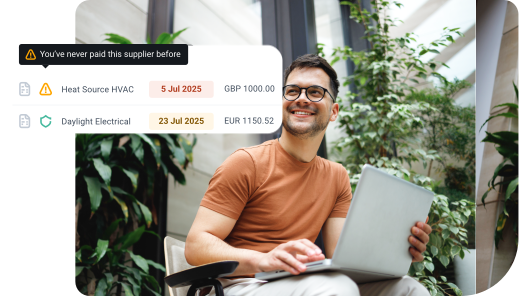
A simple example of an AI agent in practice could be automatically chasing outstanding invoices or missing paperwork every Monday, freeing up your team’s time while maintaining full visibility and control.


Building an AI-enabled accounting practice
An AI-enabled practice isn’t one that replaces people with technology. It’s one that uses automation to create capacity. Allowing teams to focus on client relationships and higher-value work.
This is where embedded, accounting-specific AI makes the difference.
Rather than relying on disconnected tools, firms need AI that sits directly within their bookkeeping and accounting workflows — with transparency, auditability, and human oversight built in.
How Dext uses AI to power smarter bookkeeping
Dext uses AI and automation to enhance every stage of the bookkeeping process, from data collection to reconciliation and reporting.
Our AI-driven features are designed to reduce manual work while keeping accountants firmly in control.
For example, Dext can:
Collect documents from clients via mobile, email-in, or WhatsApp capture.
Extract and categorise data accurately.
Match documents to bank transactions using bank feeds and statement extraction.
Support reconciliations with clear visibility.
How AI agents will transform bookkeeping workflows
One emerging example of AI-powered automation is tracking categories.
Imagine a client who regularly uses overseas suppliers. Each invoice arrives from a known supplier in a specific country. An AI-enabled workflow can:

Identify the supplier and region.

Automatically apply the correct tracking category.

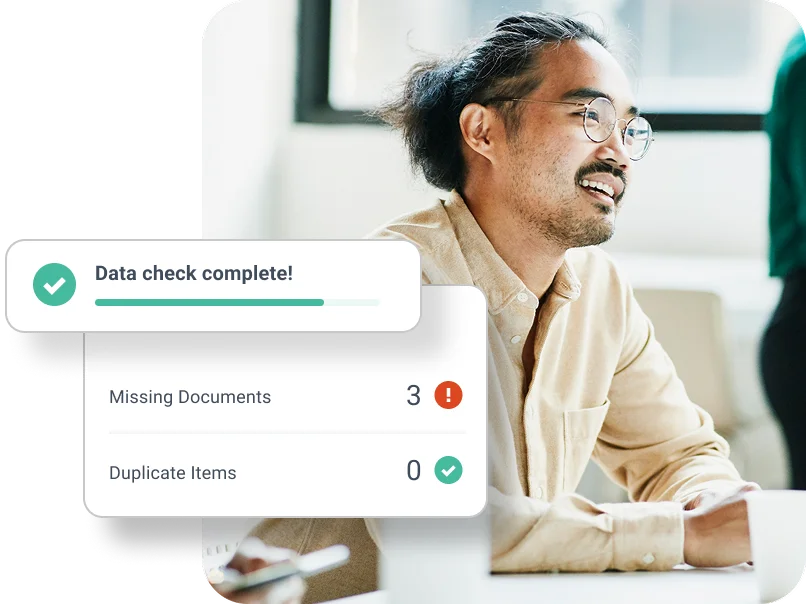
Present the result for review — not silent posting.
The result is significant time savings without sacrificing accuracy or control. That balance of automation with visibility is critical to building trust in AI-enabled bookkeeping workflows.

Avoiding common pitfalls when adopting AI
As firms increase their use of AI, a few principles matter more than ever:

Don’t outsource judgement to generic AI tools
Keep AI within regulated, auditable workflows.
Maintain human oversight at every stage.
Choose tools trained for accounting accuracy, not general knowledge.
AI should support your expertise, not replace it.
Start your AI-powered practice journey with Dext
AI is reshaping accounting — but the firms that succeed will be those that adopt it intentionally, safely, and strategically.
With accounting-specific AI, built-in controls, and automation designed for real-world workflows, Dext helps you embrace innovation without increasing risk.
Book a demo or explore how Dext can support your AI-enabled practice, and start your free 14-day trial today.
