Overqualified for the admin, irreplaceable for everything else. Where AI ends and your judgement begins. Download insights →

How to price for MTD for IT in 2026. Quarterly changes the maths.
Everything you need to build a pricing model that reflects what your firm actually does — from tiering services to telling clients the fee has changed.
Download the MTD for IT pricing guide

MTD for IT changes the work. It should change the fee.
Quarterly updates. More client questions. Support that runs all year instead of once a year.
Compliance has stopped being an annual event, so a fee built around an annual event will not hold. This guide helps you build one that covers the work — for your firm, your clients and your margin.

Why pricing for MTD for IT matters
More submissions, more support. Your fee should say so.
Switching from one annual tax return to five touchpoints a year is more than just admin. It changes how your firm operates.
You’ll be:
- In contact with clients more often
- Answering more setup and software questions
- Helping them understand new processes
- Providing ongoing support and troubleshooting
That effort is real, and your fee should account for it.
There is an upside. Quarterly data arrives while the year is still running, so cash flow insight, forecasting and the advice clients actually value become possible in-year rather than in hindsight.
More work, and more worth charging for. Price for both.
Pro tip: show clients what is changing on your side as well as theirs. A fee rise explained is a fee rise accepted.
Three pricing models that hold up
No single model fits every client. These three give you a structure to start from.

1. Tiered service model
Lets clients choose the level of service they want. It also puts who-does-what in writing, which matters on the day somebody asks.
| Service Level | What’s Included? | Price (Monthly) |
|---|---|---|
| Bronze/Basic (DIY support) |
Software access, email/phone support, quarterly submission checks. Client does the uploading and categorisation of all transactions |
£xx |
| Silver/Standard (Hybrid Approach) |
MTD software + setup, client uploads transactions, accountant/bookkeeper then categorises all transactions |
£xx |
| Gold/ Advanced (Full Service) |
All bookkeeping completed by the accountant/bookkeeper - paperbag job plus everything from the other packages. |
£xx |
You can even add a fourth package: the client handles all the bookkeeping and submissions, and you're only involved at final declaration stage.
2. Volume-based pricing
Built for clients with high transaction counts. Charge for the volume you process and the fee tracks the work rather than the calendar.
It stands on its own, and works harder alongside service tiers.
| Transaction Volume (Monthly) |
Price (Monthly) |
|---|---|
| 0 - 50 transactions |
£xx |
| 51 - 200 transactions |
£xx |
| 201 - 500 transactions |
£xx |
| 501+ transactions | Custom pricing |
3. Hybrid model
The two models combined: a base fee for the service tier, multiplied by the transaction band. Clients doing their own bookkeeping sit at the lower end, and the fee rises with the volume rather than with the invoice date.
1-50 transactions
| Tier |
Base monthly fee |
Transactions | Multiplier | Total monthly fee |
|---|---|---|---|---|
| Bronze | £50.00 | 1-50 | 1 | £50.00 |
| Silver | £75.00 | 1-50 | 1 | £75.00 |
| Gold | £100.00 | 1-50 | 1 | £100.00 |
51-200 transactions
| Tier |
Base monthly fee |
Transactions | Multiplier | Total monthly fee |
|---|---|---|---|---|
| Bronze | £50.00 | 51-200 | 1.25 | £62.50 |
| Silver | £75.00 | 51-200 | 1.25 | £93.75 |
| Gold | £100.00 | 51-200 | 1.25 | £125.00 |
201-500 transactions
| Tier |
Base monthly fee |
Transactions | Multiplier | Total monthly fee |
|---|---|---|---|---|
| Bronze | £50.00 | 201-500 | 1.5 | £75.00 |
| Silver | £75.00 | 201-500 | 1.5 | £112.50 |
| Gold | £100.00 | 201-500 | 1.5 | £150.00 |

Things to consider with the Hybrid model
- More transactions, more time: build it into the fee before it eats the margin.
- Don’t sell gold service at a bronze price: poor record-keeping makes the work bigger, not smaller.
- Use an income stream multiplier: more income streams mean more complexity, and the price should follow.
- Use proposal software: moving a client from annual to quarterly billing is a system job, not an admin job.
Pro Tip: No matter the model, make sure your service scope is clear and documented. Ambiguity causes client confusion and team stress.
Add-on services. Compliance is the way in, not the whole offer.

| Additional Service | Pricing |
|---|---|
| MTD for IT software setup & training (this benefits everyone – particularly those on the cheapest package as you could establish set rules, ensuring more accurate records at the end) |
£xx (one-time) |
| Quarterly tax planning consultation | £xx per session |
| Annual accounts (if required) &
Self-assessment filing (finalisation) |
As before. |
Use this shift to position yourself as a proactive advisor:
- Quarterly reviews & check-ins
- Proactive cash flow planning
- Receipt digitisation and bank feed setup
- Reconciliation and bookkeeping upsells
Pro tip: the margin on advisory depends on the state of the data underneath it. Dext Solo captures and categorises client transactions for you, so correcting them stops being the job.
What to weigh up before you set a number
Complexity, volume and risk vary by client, so the fee should vary with them.
Price too low and you fund the work yourself. Price too high and the client goes shopping. The room between the two gets wider the better you scope the service, tier the offer and explain what the money buys.

The Goldilocks zone
Clients spread sensibly across your tiers, each tier worked at the right intensity, and margins that survive the year.
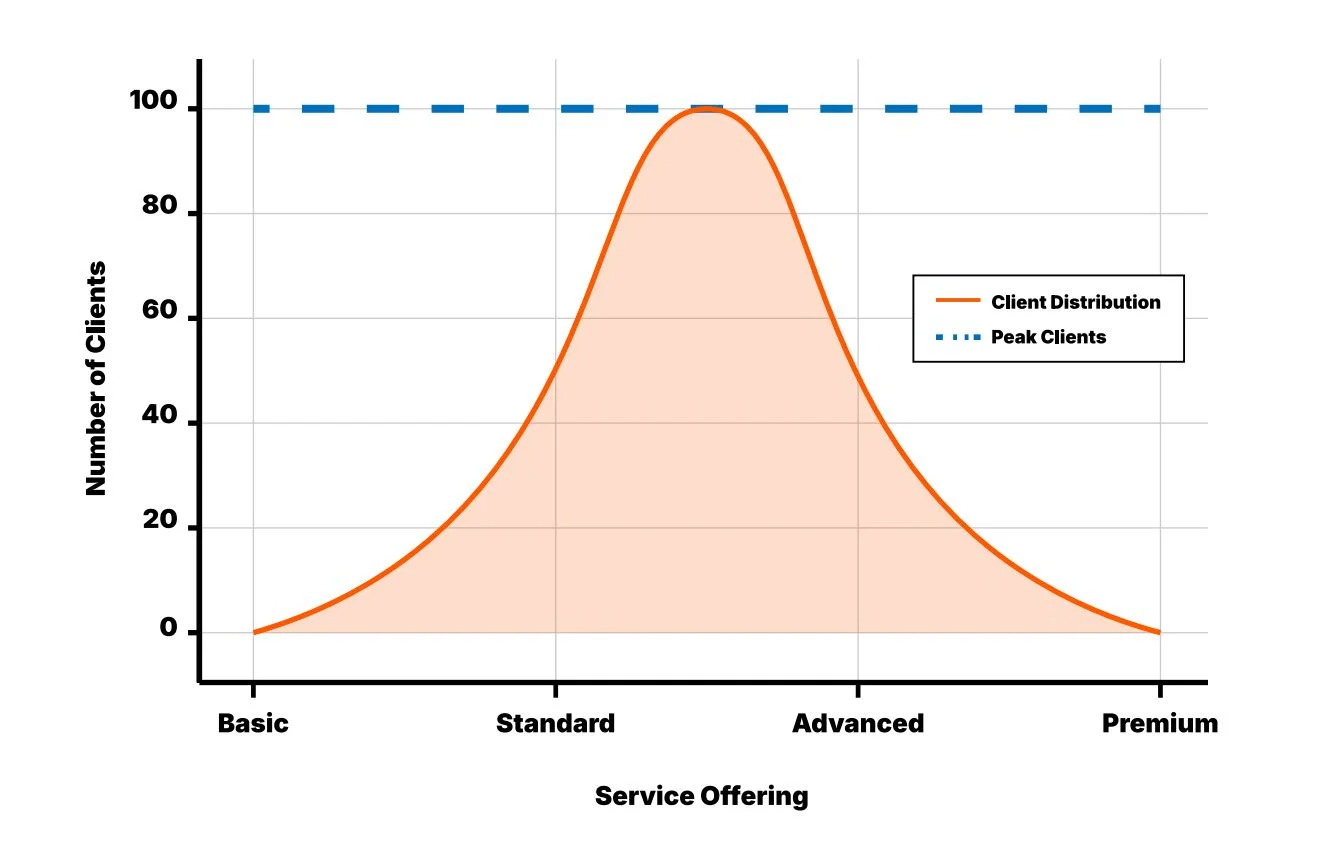
When building or adjusting fees, consider:
- Spread matters: if everyone lands in one tier, the tiers aren’t doing their job.
- Price drives behaviour: if most clients pick the top tier, the top tier is too cheap.
- Profit in every tier: a tier that only breaks even is a tier you are subsidising.
- Segmentation works: tiers let you meet different expectations without a bespoke quote each time.
- Keep demand distributed: the right prices spread clients across the range.
- Watch the extremes: a lopsided client mix is a pricing signal, not a coincidence.
Pro tip: the costs that ruin a fee are the unbilled ones — chasing documents, correcting categorisation, redoing a quarter. Nobody quotes for them. Everybody pays for them.
Telling clients the price has changed

Don’t let a new number turn up on its own. Before it does:
- Show how the scope of the work has changed
- Spell out what you now do that you didn’t before
- Give people time to ask questions, early
- Offer a choice — a tier is easier to accept than a rise
Pro tip: put the before and the after side by side. A comparison argues better than a paragraph.
Need the words as well as the numbers? The full PDF carries objection-handling templates and sample emails for the conversation nobody enjoys starting. → Download the full PDF.
Prefer to start from your own client list? Put the numbers through the calculator.
Where this leaves you
Clear tiers, a fee that matches the work, and clients who know why it changed. That is the whole strategy.
Agree it internally now, before the quarterly cycle starts deciding it for you.
Prefer a printable version?
Download the PDF pricing guide — objection-handling scripts and email templates included.
Want to go deeper?
The Making Tax Digital guide has the timelines, the pricing advice and the rollout steps, written for practices.
Looking for the right software?
Dext Solo handles the quarterly cycle for MTD for Income Tax — capture, categorisation and the updates that go to HMRC — alongside your finalisation software or on its own. Also in the mobile app.
Ready to go deeper?
The rest of the MTD for IT reading, for the parts of the rollout that pricing doesn’t settle.



Dext’s HMRC-recognised
MTD software
Dext Solo is a digital record-keeping solution built to help you manage MTD for Income Tax and quarterly updates. We handle the hard part: getting accurate data in, fast and at scale. It’s easy to use and works with your preferred finalisation software or on its own.